
How Far Can an Electric Golf Buggy Go on One Charge? Real-World Australian Range Testing
Electric golf cart range: Data-backed range testing across 18-hole courses, gated communities, and hilly rural acreage. How lithium capacity (Ah), payload, terrain, and speed affect total kilometers.
Understanding Real-World Range vs Factory Marketing Claims
One of the most frequent inquiries from prospective buggy buyers is: "How far can it actually drive on a single full charge?" While factory laboratory testing often quotes theoretical ranges based on a single 70kg driver on flat asphalt, real Australian conditions involve golf bags, multiple adult passengers, hilly fairways, gravel driveways, and variable weather. Below are the verified results from our Yatala technical testing team.
Test Scenario 1: Standard 18-Hole Golf Round (Flat to Rolling Fairways)
A typical 18-hole round of golf covers 7 to 9 kilometers of driving, including navigating between greens, tees, and cart paths. A 48V 105Ah lithium buggy operating on fairway turf consumes roughly 12% to 15% of its total battery capacity per round. That means you can comfortably complete four full 18-hole rounds (36 to 45 holes over a weekend) on a single charge without plugging into a wall charger.
Test Scenario 2: Gated Estate Cruising & Street Travel (Sanctuary Cove / Hope Island)
When operating a 4-passenger road-permitted buggy on paved community streets at cruising speeds of 25km/h to 35km/h, smooth asphalt minimizes rolling resistance. In our road trials, a 48V 105Ah lithium Atlas buggy achieved 78 kilometers of continuous driving before the digital battery gauge reached 15% reserve.
- •Average speed maintained: 22km/h.
- •Passengers: 2 adults (160kg payload).
- •Elevation: Flat coastal terrain with occasional bridge ramps.
- •Result: 78.4km total distance on a single 3-hour charge.
Test Scenario 3: Heavy Acreage Paddock Work & Hill Towing
Operating on a 25-acre semi-rural property presents the most demanding energy challenge. Traversing thick pasture grass, rocky creek crossings, and pulling a 200kg utility trailer up 15-degree slopes increases motor current draw from 45 amps to 180+ amps. Under these heavy-duty conditions, range averages 45km to 55km—more than enough for a full day of fencing and property inspection.
The Regenerative AC Braking Advantage
Modern buggies equipped with AC brushless motors feature bidirectional motor controllers. Whenever you lift your foot from the accelerator on a downhill descent, the motor reverses into a generator, applying electronic braking while feeding up to 35 amps back into the lithium battery pack. On undulating golf courses, this regenerative harvesting returns roughly 10% of expended energy.
Upgrading Battery Capacity for Commercial Demands
For commercial resorts, security patrols and industrial worksites running long daily hours, the answer is usually more capacity rather than a different vehicle. Our stocked lithium upgrades run to 48V 105Ah, and where a duty cycle genuinely needs more than that we will quote it against your actual usage rather than sell you a pack sized by guesswork. Tell us the hours, the terrain and the load and we will work out what the shift really requires.
The Variables That Move Real Range Most
Published range figures assume conditions that rarely match a real property or course, and four variables account for most of the gap. Total weight is the largest: passengers and cargo are the difference between a comfortable round and an anxious final few holes. Terrain is next, since sustained climbing draws far more current than distance alone suggests, and a short hilly route can consume more than a long flat one. Tyre pressure and rolling resistance quietly cost range every trip. Finally, temperature affects available capacity, with both very cold mornings and very hot afternoons reducing what the pack will deliver. Estimating your own worst realistic case, rather than the advertised best case, is the sensible way to size a battery.
Driving Habits That Extend Range Noticeably
How a buggy is driven changes its range more than most owners realise, and none of the adjustments require sacrificing much. Smooth, progressive acceleration draws far less peak current than repeatedly flooring it from stationary, and the peaks are what heat the pack and controller. Anticipating stops instead of braking hard preserves momentum, and on a vehicle with regenerative braking it also returns some energy rather than turning it into brake heat. Avoid leaving the buggy idling in forward against the brake on a slope, which draws current while achieving nothing. On long descents, letting regeneration slow the vehicle rather than riding the brakes both extends range and reduces brake wear at the same time.
Frequently Asked Questions
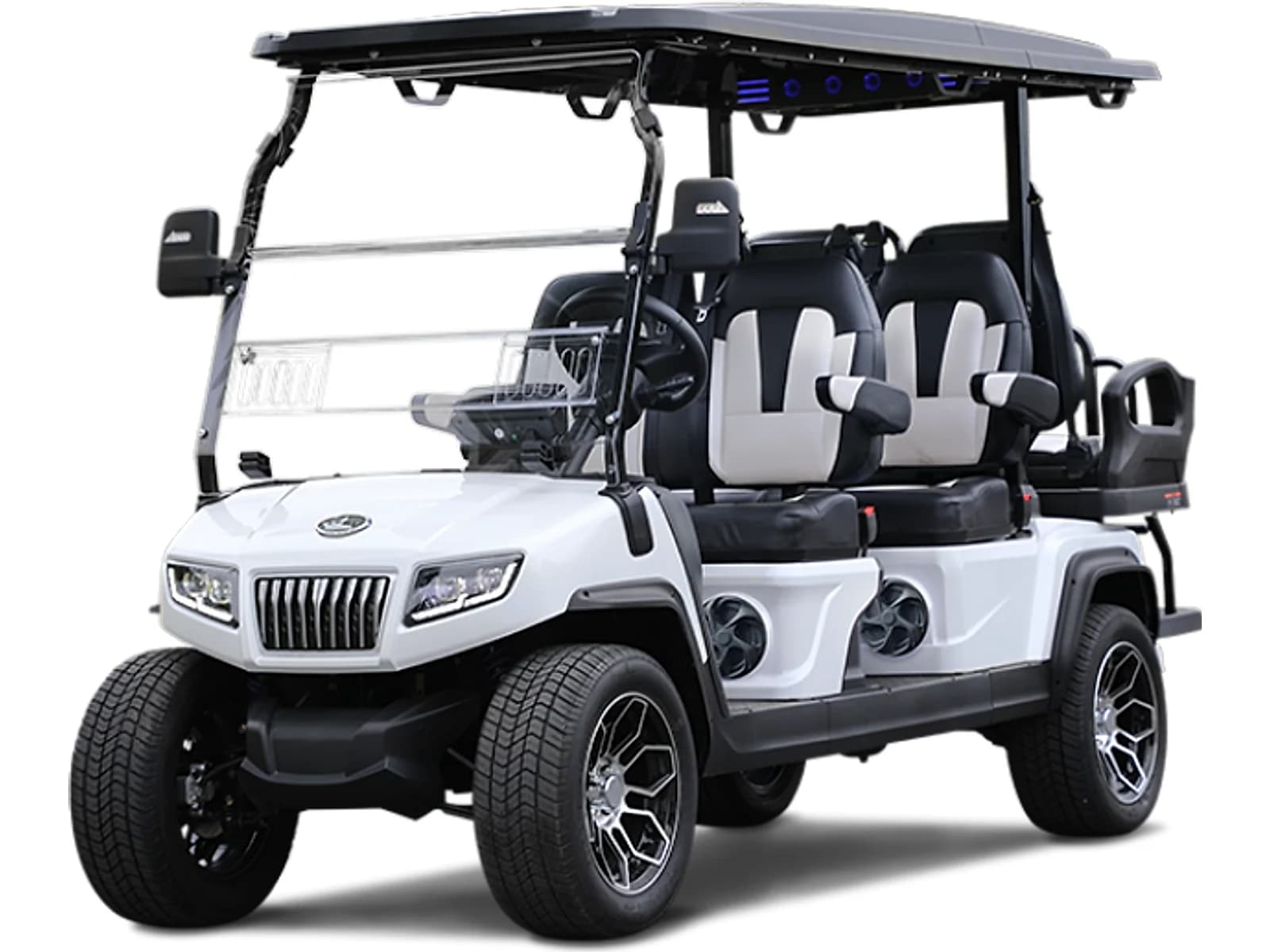
Evolution D5 Ranger 4+2 Plus
110Ah Lithium, Soundbar with Bluetooth, 9-inch Touchscreen, Foldable Windshield, Forward Facing Seats. Available for immediate dispatch from our Yatala QLD depot with nationwide enclosed delivery.
More Australian Golf Buggy Guides
Solar Panels on Golf Buggies: Does Roof Solar Recharging Actually Work in Australia?
An engineering analysis of flexible monocrystalline solar roofs on golf buggies and farm carts. Daily kilowatt-hour harvest, MPPT charge controllers, and battery cycle extension.
Lithium vs Lead-Acid Golf Buggy Batteries: 10-Year Total Cost & Heat Performance in Australia
Comparing LiFePO4 lithium against flooded lead-acid and AGM packs in harsh Australian heat. Weight savings, cycle life, charging times, and true 10-year total cost of ownership.
AC vs DC Motors in Modern Golf Buggies: Torque Curves, Hill Climbing & Maintenance Compared
Technical breakdown of brushless Alternating Current (AC) versus traditional Direct Current (DC) golf buggy motors. Why modern AC drivetrains dominate Australian hills and acreage.